Inbox zero without the daily effort
Inbox zero fails when it depends on a decision for every message, every day. Decide once for each sender, keep reading and records out of the inbox, and give "later" a place, and the inbox reaches zero with little work.
You have tried inbox zero before. One evening you cleared everything, and the empty list felt good. Ten days later there were two hundred messages again, and you stopped trying.
The method did not fail because you lack discipline. It failed because it asked you for a decision on every message, every day, for the rest of your life.
Where the effort goes
Count what arrives in a normal week. A few messages come from people who need an answer. The rest are newsletters, receipts, notifications and mail from strangers.
The usual advice says to process each one: delete, file, answer or defer. That is a hundred small decisions to protect five conversations. The effort is in the wrong place.
An inbox reaches zero easily when most mail never enters it.
Change 1: decide for each sender, once
A newsletter sends fifty issues a year. If you decide where each issue goes, that is fifty decisions. If you decide where the sender goes, that is one.
Do this for every sender, the first time they write. People go to the inbox. Newsletters go to a reading place. Receipts go to a records place. Strangers you did not ask for go nowhere.
Change 2: keep the inbox for mail that needs you
After change 1, the inbox holds only conversations with people and matters that ask you to act, such as a bill or a form. This list is short, and you can finish it.
Reading and records are still there, in their own places, and they do not count against you. A reading list with twelve unread newsletters is not a failure. It is a shelf.
Change 3: give “later” a place
Many messages stay in an inbox because of one thought: “I cannot deal with this now.” If “later” has no place of its own, the message stays where it is.
“Later” means three different things, and each needs its own mark.
- You owe an answer. Put the message in a reply queue, and answer the whole queue in one sitting.
- You need the details soon. A ticket or an address goes somewhere close, for reference.
- It matters on another day. Hide it until that day, and have it return on its own.
With these three marks, every message can leave the inbox the first time you read it.
Change 4: let old mail remove itself
Nobody reads a delivery notice from last spring. Set an age for reading and for records, and let mail older than that delete itself. You never need to “clean up” again.
What a day looks like
Morning: look at the new senders, which takes about a minute. Read the short inbox. Answer what is quick, and mark the rest. Once a day, or twice a week, open the reply queue and answer everything in it. Read newsletters when you want something to read.
The inbox is at zero most of the time, and you did not spend an evening to get it there.
In Kistrl
Each change is a part of Kistrl.
- Once for each sender: the Doorway holds first-time senders until you choose a place.
- A short inbox: newsletters go to the Feed and receipts to Paper trails. Catch up lines up everything unread as one list.
- A place for later: Reply later, Set aside and Bubble up, and Focus & Reply to answer the whole queue.
- Mail that removes itself: Recycling, which never touches mail you marked or have not read in your Inbox.
Read Three kinds of “not now” for the marks in detail.
Give the answers you owe their own time.
Arjun asked Sam for lecture notes. Mei suggested a study session. Both conversations are already marked Reply later, ready for a deliberate reply session.
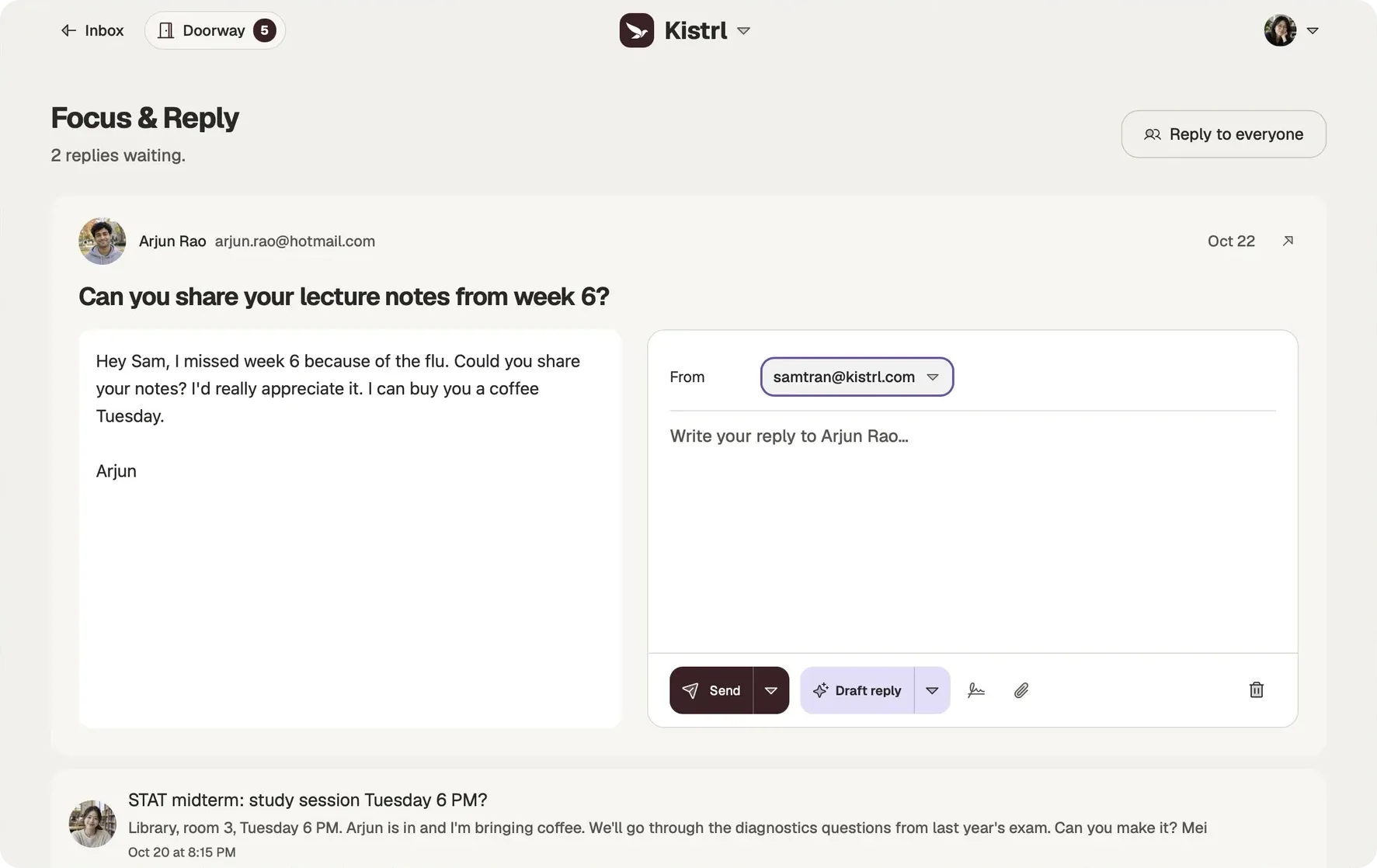
Reply later for an answer owed.
Mark a conversation when someone is waiting on you. It joins Focus & Reply.
Set aside for a detail to keep.
Keep financial-aid instructions close without treating them as an answer you owe.
Bubble up for a chosen time.
Choose when an eligible Inbox conversation should return. The three marks are independent.