Reply later, set aside or snooze: three kinds of "not now"
Leaving a message unread is how most people say "later". It works until it does not. Naming what kind of later you mean keeps nothing from slipping.
There is a message you cannot deal with right now. Maybe you need to check something first, or you will need its details next week, or it simply does not matter until Friday. The most common response is to leave it unread, or to mark it unread again after opening it.
That works for a few messages. After a while the unread count fills with very different kinds of “later”, and none of them can be told apart.
Later means three different things
I owe someone an answer. The message needs a reply from you, and someone is waiting. Forgetting it has a cost.
I will need this again. A booking reference, an address, instructions for the new heater. Nothing to do now, but you want it close at hand.
Not until a certain day. The invitation that matters a week before the event. The reminder that is only useful on the day.
Each one deserves a different tool. Treating them all as “unread” mixes debts with reference material and with things that should be invisible for now.
Give each its own mark
- A reply queue for answers you owe. Its whole point is to become empty. When you sit down to reply, you work through it in one go.
- A reference shelf for things to keep close. It never needs to be empty; you take things off it when you no longer need them.
- A timer for things that should come back. The message leaves your sight and returns at the time you chose.
Keep them separate. A message can belong to more than one: a booking you need to confirm by Friday is both an answer you owe and something you will need again.
Answer in batches
The reply queue pays off when you clear it in one sitting. Switching between reading new mail and writing answers is tiring; doing all the writing at once is not. Set aside a short block, open the queue, and work down it.
In Kistrl
Kistrl has all three as marks on a conversation: Reply later, Set aside and Bubble up. They are independent, so a conversation can carry more than one, and Focus & Reply lines up every Reply later with the original on one side and your answer on the other. Marked conversations are never recycled. See Follow-up.
Give the answers you owe their own time.
Arjun asked Sam for lecture notes. Mei suggested a study session. Both conversations are already marked Reply later, ready for a deliberate reply session.
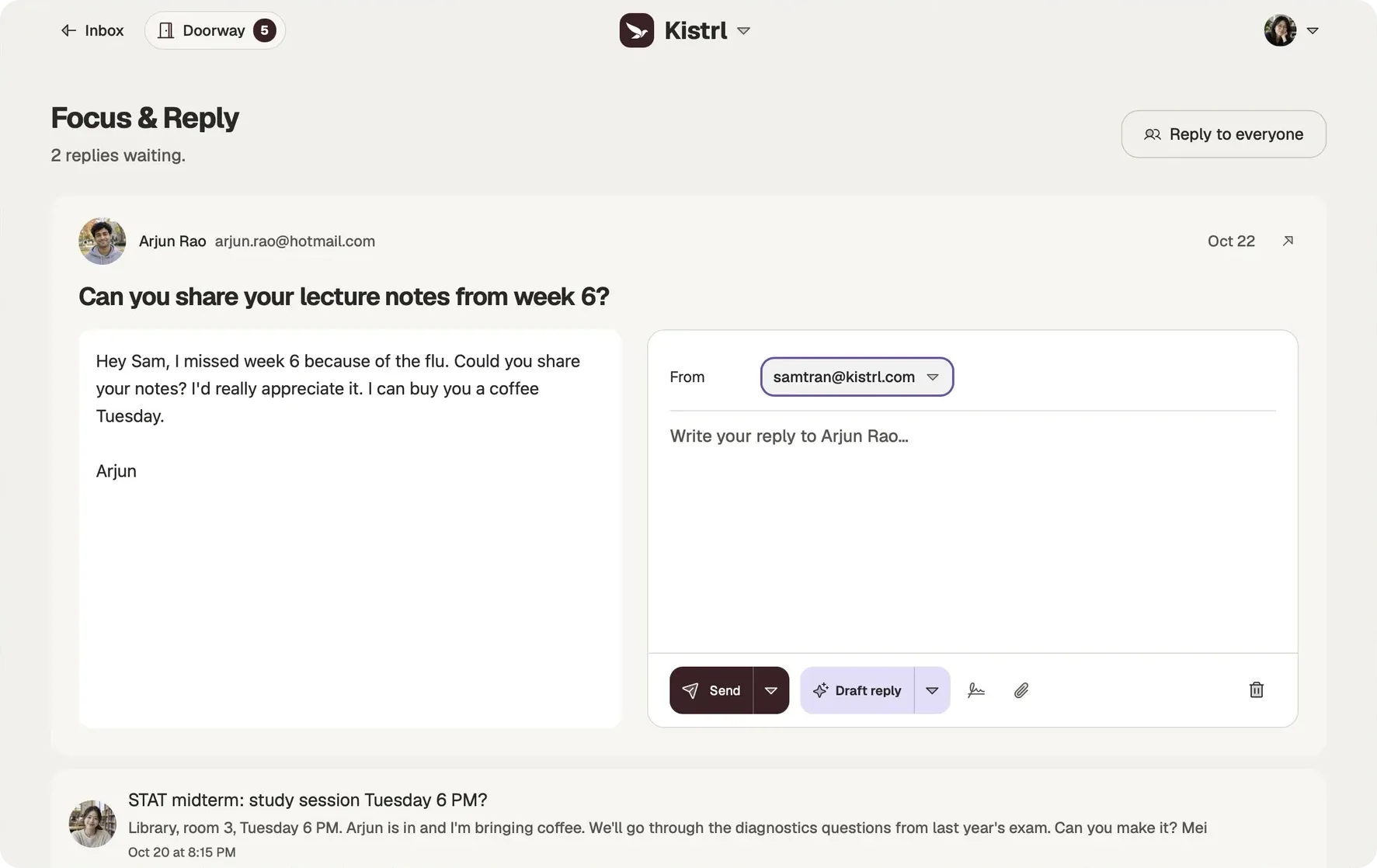
Reply later for an answer owed.
Mark a conversation when someone is waiting on you. It joins Focus & Reply.
Set aside for a detail to keep.
Keep financial-aid instructions close without treating them as an answer you owe.
Bubble up for a chosen time.
Choose when an eligible Inbox conversation should return. The three marks are independent.